





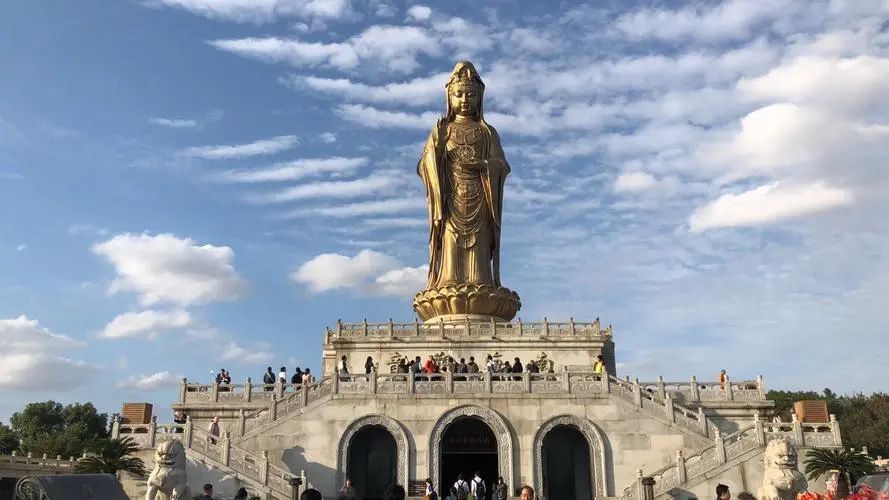
Mount Putuo
Putuoshan is one of China’s four sacred Buddhist mountains and a renowned island scenic spot. Such a beautiful island, with so many cultural relics and historical sites, is virtually unique in China. Located about 100 nautical miles east of Hangzhou Bay in Zhejiang Province, Putuoshan is a small island in the Zhoushan Archipelago. The island covers an area of 12.5 square kilometers, is long and narrow, with a maximum north-south length of 8.6 kilometers and a maximum east-west width of 3.5 kilometers. Its highest point, Foding Mountain, is about 300 meters above sea level.
Putuoshan truly embodies the beauty of both mountains and sea.
The seascape of Putuoshan, from any scenic spot to any location, evokes a sense of vastness and openness. Even with howling winds and towering waves, one doesn’t feel a sense of awe or fear, but rather a feeling of exhilaration from these extraordinary sights. As a Buddhist holy site, Putuoshan at its peak boasted 82 temples and monasteries, 128 hermitages, and over 4,000 monks and nuns. Visitors strolling along the island’s paths often encounter monks in their robes. The beautiful natural scenery and rich Buddhist atmosphere lend it a mystical air, which is precisely what makes it so appealing to tourists.
Putuoshan is renowned for both its magnificent seascape and its deep forests. Climbing the mountain and gazing at the azure sea, one sees islands floating on the surface, dotted with white sails—a truly enchanting sight. An ancient saying aptly describes Putuoshan: “For mountains combined with the beauty of a lake, West Lake is the best; for mountains combined with the beauty of the sea, Putuoshan is the best.” Comparing Putuoshan to the earthly paradise of West Lake is, arguably, an objective assessment.
Main Scenic Spots
Putuoshan boasts numerous scenic spots and tourist attractions, the most prominent being the three major temples: Puji, Fayu, and Huiji, which are the largest of the more than twenty temples and monasteries still preserved today. Puji Temple, originally built in the Song Dynasty, is the main temple in the mountain dedicated to Guanyin, with a total building area of over 11,000 square meters. Fayu Temple, built in the Ming Dynasty, is nestled against the mountain, its buildings cascading down the slope, surrounded by ancient trees, creating a tranquil atmosphere. Huiji Temple, also known as Foding Mountain Temple, is located on Foding Mountain. The island boasts numerous strangely shaped rocks, including the famous Pantuo Stone, the Two Turtles Listening to the Dharma Stone, and the Sea-Sky Buddha Kingdom Stone, among more than twenty others. At the junction of the mountain and the sea, there are many scenic caves, the most famous being Chaoyin Cave and Fanyin Cave. The island has many beaches, but the main ones are Baibu Beach and Qianbu Beach. Qianbu Beach is an arc-shaped beach, about 3 li long, with fine sand, a gentle slope, and a wide, soft surface, making it an excellent bathing beach. In summer, visitors can bring their swimsuits and enjoy swimming here. The island is lush with trees, its forests secluded and beautiful, including camphor trees, podocarpus, ginkgo, and albizia. There are over 1,000 large camphor trees along the island. There is a thousand-year-old camphor tree with a circumference of 6 meters, providing shade for several acres. There is also a Carpinus hornbeam, a rare and precious tree species in China, listed as a national second-class protected plant. Many folk tales about Buddhism are told on Mount Putuo.
