





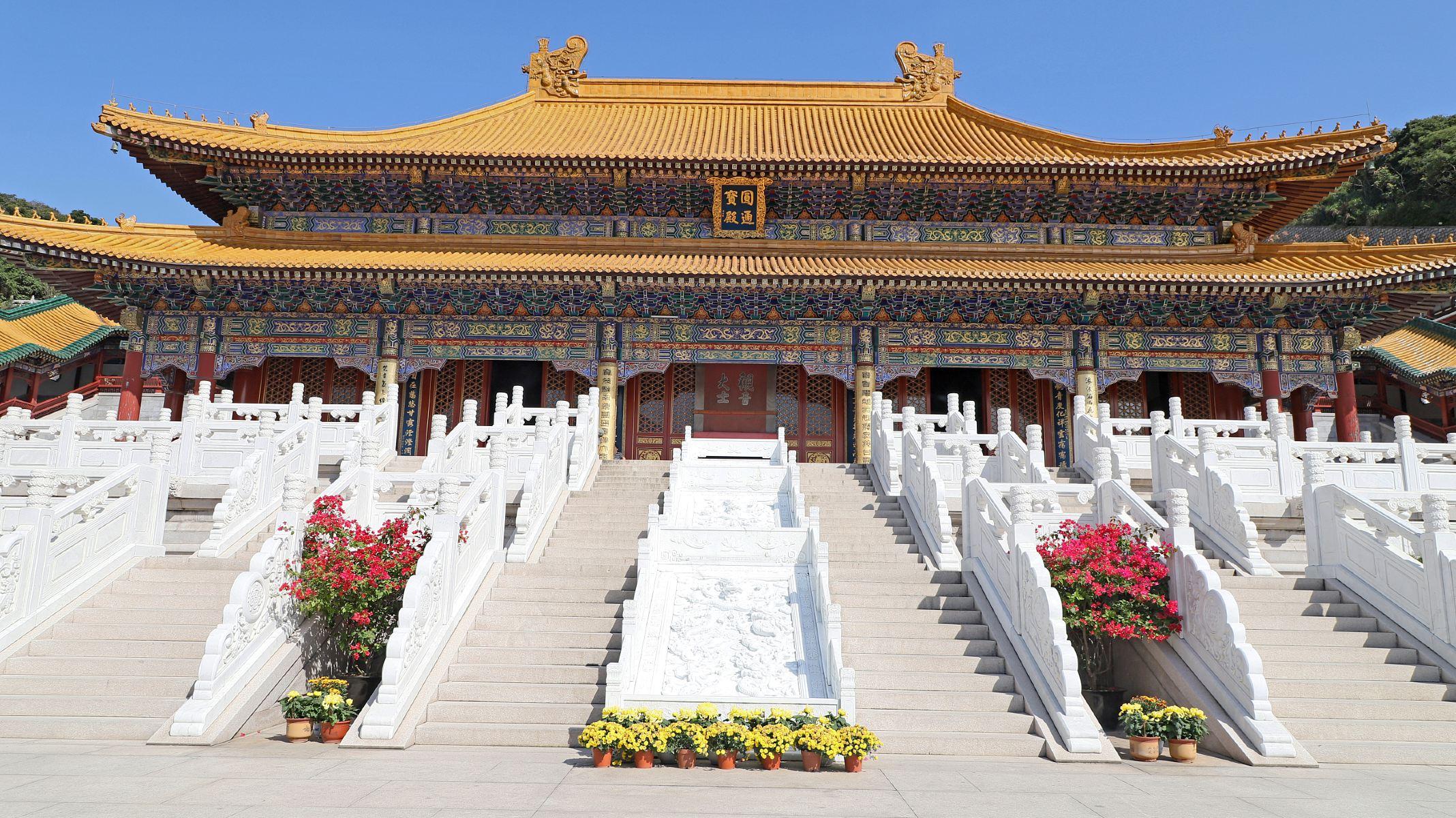
Introduction to Putuoshan Scenic Spots
Putuoshan, located in the southeastern part of the Zhoushan Archipelago, is one of the first 44 national-level key scenic spots designated in China. Along with Wutai, Emei, and Jiuhua, it is known as one of the four sacred Buddhist mountains in China, and was praised by the ancients as a “Buddhist Kingdom by the Sea.” The Qing Dynasty poet Kang Youwei wrote a poem praising it: “Guanyin passed by and refused to leave; the divine mountain of Putuoshan rises from the sea. Two hundred temples, high and low, rise and fall; fish and dragons roar and surge amidst thousands of waves.” It is renowned at home and abroad for its beautiful marine scenery and profound Buddhist culture, and boasts a fresh, mild, and pleasant climate.
The Putuoshan Guanyin Bodhisattva pilgrimage site was first built in the fourth year of the Xiantong era of the Tang Dynasty (863 AD). It experienced periods of prosperity and decline throughout the dynasties. At its peak, the wharf was lined with incense boats, and it once had three major temples, eighty-eight nunneries, and one hundred and twenty-eight hermitages, known as “five hundred monasteries and three thousand monks.”
Currently, the three major temples of Puji, Fayu, and Huiji, as well as more than thirty other Zen monasteries such as Dacheng, Meifu, and Zizhulin, still offer opportunities for pilgrimage and sightseeing. The “South China Sea Guanyin,” standing 33 meters tall, possesses a solemn and compassionate Buddha image, attracting throngs of visitors. The mountain boasts numerous cultural relics, including the Yuan Dynasty’s Duobao Pagoda, the “Nine Dragons Hall” relocated from the Ming Dynasty Palace in Nanjing, and the “Willow Branch Guanyin Stele” built during the Wanli period of the Ming Dynasty, collectively known as the Three Treasures of Putuo Mountain. The scenic area enjoys convenient transportation by sea and air, with standardized management, good order, and comprehensive service facilities. It has successively been awarded the titles of National Sanitary Mountain, National Safe Mountain, National Civilized Mountain, and 4A-level Tourist Attraction.
Putuo Mountain stretches 8.6 kilometers from north to south and 3.5 kilometers from east to west. Its highest peak, Foding Mountain, reaches an altitude of 288.2 meters, making it one of China’s four sacred Buddhist mountains. The Buddhist scripture Avatamsaka Sutra records that “Avalokitesvara Bodhisattva arrived at Mount Putuo,” establishing Putuo as a sacred site for Guanyin. In 863 AD, during the fourth year of the Xiantong era of the Tang Dynasty, the Japanese monk Hui’e brought a statue of Guanyin (Avalokitesvara) from Mount Wutai back to Japan. Due to storms, he landed at Chaoyin Cave and built the “Guanyin Temple That Refused to Leave,” marking the beginning of Buddhism on Mount Putuo. In 1214 AD, during the seventh year of the Jiading era of Emperor Ningzong of the Song Dynasty, Mount Putuo was officially designated as the sacred site of Guanyin Bodhisattva, becoming one of the four great Buddhist mountains along with Mount Wutai, Mount Emei, and Mount Jiuhua. Subsequent emperors allocated funds for its construction, and its incense offerings flourished. At its peak, strolling along the island’s paths, one could often encounter monks in their robes. The beautiful natural scenery and the rich Buddhist atmosphere imbued it with a mystical aura. On the 29th day of the ninth lunar month in 1997, the open-air bronze statue of Guanyin in the South China Sea was completed. On that day, under a sky full of dark clouds, when Abbot Miaoshan announced the consecration of the statue, the sky opened, and sunlight streamed in, especially captivating believers from home and abroad.
Climbing the mountain and gazing at the azure sea, one sees islands floating on the water, dotted with white sails—a truly captivating sight. The ancients praised Putuoshan highly: “For mountains combining the beauty of a lake, West Lake is the best; for mountains combining the beauty of the sea, Putuoshan is the best.” Comparing Putuoshan to the earthly paradise of West Lake is, arguably, an objective assessment. The seascape of Putuoshan, from any scenic spot to any location, evokes a sense of vastness and boundless expanse. Even with howling winds and towering waves, one doesn’t feel a sense of dread, but rather a feeling of exhilaration from these extraordinary sights.
Main Attractions
The First Buddhist Kingdom of China: Putuoshan is a world-renowned Guanyin Bodhisattva pilgrimage site and Buddhist holy land, its religious activities dating back to the Qin Dynasty. During the Tang Dynasty, the rise of the Maritime Silk Road facilitated the formation of Putuoshan as a Guanyin Bodhisattva pilgrimage site, quickly becoming a center of Han Chinese Buddhism, spreading to Southeast Asia, Japan, and Korea. By the late Qing Dynasty, the mountain had developed into a hub with 3 major temples, 88 monasteries, and 128 hermitages, housing thousands of monks. As the saying goes, “Temples are hidden wherever the mountain bends, and monks appear again when the road seems to end,” historically known as “the first Buddhist kingdom in China.” During Buddhist ceremonies, believers from all directions gathered at this sacred site, often witnessing auspicious celestial phenomena and receiving frequent miraculous responses to their prayers. Over a thousand years of Buddhist activities have endowed Putuoshan, this spiritually rich and beautiful land, with a profound Buddhist cultural heritage. “Everyone chants Amitabha, every household worships Guanyin,” the Guanyin faith is known as “the faith of half of Asia.”
The Purest Place on Earth: Surrounded by the sea on all sides, Putuoshan boasts enchanting scenery and a unique, ethereal atmosphere, earning it the reputation of “the purest place on earth” since ancient times. Golden sands, strange rocks, caves, the sound of the tides, and mirages blend seamlessly, creating a unique landscape where mountains and sea merge into one. The scenic area enjoys four distinct seasons, with mild summers and winters, belonging to the subtropical maritime climate. The average annual temperature is around 20℃, and the annual rainfall is around 1100 mm. With the ebb and flow of the tides, the island boasts year-round fresh air of exceptional quality, rich in negative oxygen ions, making it a natural “oxygen bar.” The forest coverage reaches 80%, with numerous ancient and famous trees, fragrant flowers and exotic plants everywhere, especially the Putuo hornbeam, a unique species in the world and a rare and endangered national first-class protected plant. The mountain is home to more than 30 species of animals classified as national second-class or above, making it a natural paradise for wildlife.
Twelve Scenic Spots
Putuo Mountain boasts a unique landscape combining mountains and sea, with ever-changing scenery throughout the four seasons and distinct features at dawn and dusk. It has hundreds of scenic spots, offering endless beauty. Like other famous scenic spots, Putuo Mountain also has its own “scenic spots within scenic spots.” Famous figures throughout history who visited Putuo Mountain have praised its scenery in various ways, creating descriptions such as “Eight Views of Putuo,” “Ten Views of Putuo,” “Twelve Views of Putuo,” and “Sixteen Views of Putuo.” The Ming Dynasty writer Tu Long wrote a poem about the “Twelve Views of Putuo”: Plum Bay in Spring Dawn, Tea Mountain in Morning Mist, Ancient Cave Tide Sounds, Turtle Pool in Cold Green, Main Gate with Clear Chanting, Thousand Steps of Golden Sand, Lotus Ocean at Noon Ferry, Incense Burner in Green Mist, Luojia Lights, Quiet Room with Tea Smoke, Pantuo at Dawn, and Bowl of Vast Clouds. The Putuo Mountain Gazetteer, compiled by Qiu Ban in the Qing Dynasty, lists twelve views as: Short Maiden’s Sacred Site, Buddha’s Finger Mountain, Two Caves with Tide Sounds, Thousand Steps of Golden Sand, Huading Cloud Waves, Plum Blossom Immortal Well, Rising Sun at Dawn, Pantuo at Sunset, Fahua Spiritual Cave, Light Shining After Snow, Pagoda with Bell Sounds, and Lotus Pond at Night.
Lotus Ocean at Noon Ferry
Lotus Ocean, also known as Lotus Flower Ocean, is located between Zhoushan Island and Putuo Mountain, bordering Huangdayang to the north and the Putuo Channel to the south. The name of the Lotus Ocean originates from a legend about Japanese people trying to bring a Guanyin statue back to Japan, only to have an iron lotus flower grow in the sea to prevent their crossing. The Dinghai County Gazetteer of the Kangxi era of the Qing Dynasty, quoting the Putuo Gazetteer, states: “During the Yuanfeng era of the Song Dynasty, a foreign tribute mission, seeing the extraordinary nature of the land, attempted to transport it to their country. However, an iron lotus flower grew in the sea, preventing the ship from sailing. The Japanese, fearing for their lives, returned, hence the name.”
The Lotus Ocean is an essential route for pilgrims to Mount Putuo. When travelers’ ships reach the ocean, if they arrive at midday tide, they can see the gently rising waves resembling thousands of lotus flowers undulating in the wind, a breathtaking and enchanting sight. On windy days, the waves surge and roar, creating a spectacular scene.
A fisherman’s song once described it: “The Lotus Ocean is stormy, even without wind, lotus flowers rise on the sea. One lotus flower blooms for ten miles, its petals sharp like wolf teeth.”
Short Maiden’s Sacred Site
About 300 meters southeast of the Buddhist mountain gate lies the Short Maiden’s Ditch. The beach, “over ten meters wide and a hundred meters long, is dotted with small stones, with rocks of varying sizes and shapes scattered along both sides,” some inscribed with phrases like “Short Gu Ancient Site,” appearing and disappearing amidst the tides and waves, forming a natural wharf in the past. Boats reaching the Short Gu wharf couldn’t dock directly; they had to be ferried across in small sampans no more than ten feet long and three feet wide. In 1905 (the 31st year of the Guangxu Emperor’s reign), the two monks, Liao Yu and Lian Chan, abbots of Mount Putuo, due to the inconvenience of boats docking during the ebb and flow of the tides, raised funds to build a stone slab wharf 11 meters long and 8 meters wide. Before the construction of the Mount Putuo passenger terminal, all those coming to Mount Putuo for pilgrimage, incense offerings, and sightseeing had to disembark from this wharf.
Legend has it that two sisters-in-law vowed to worship Buddha. Several years later, they pooled their money to buy a boat and set off to Lianyang to make a pilgrimage to the mountain. Just as the boat docked, the younger sister-in-law unfortunately began her period. Ashamed of her uncleanliness, she dared not disembark and enter the mountain. Her sister-in-law, feeling she was unworthy of the pilgrimage, told her to wait in the small boat while she went alone to worship Buddha. Unexpectedly, as noon approached, the tide rose high, separating the small boat from the shore. The younger sister-in-law sat in the boat for a long time, hungry and puzzled. Just then, a village woman carrying a food box came along, throwing some stones into the water as she stepped onto the stones and went straight to the younger sister-in-law’s boat. She said her sister-in-law had asked her to bring the food, and after placing the food box down, she left the boat. Not long after, her sister-in-law returned from her pilgrimage and, upon inquiring about the previous events, was astonished. She then recalled that while worshipping Buddha, she had noticed a patch of Guanyin Bodhisattva’s robes were wet. Suddenly, she understood – this was the work of Guanyin Bodhisattva. She then went back into the mountain to worship Guanyin. Because her sister-in-law had once “shorted” her aunt at the dock, the place where the two women moored their boats became known as “Short Aunt’s Dock.” The scattered stones beside the dock, appearing and disappearing in the tide, are said to be stones that the Bodhisattva threw into the tide to use as stepping stones when delivering food, hence they are called “Short Aunt’s Sacred Site.”
Plum Bay in Spring Dawn
Plum Bay in Spring Dawn refers to the early spring scenery of Putuo Mountain. Putuo Mountain is also called Meicen, because the western bay is called Plum Bay, also known as Qianwan. It is said that many wild plum trees grow here, and many monks in monasteries and hermitages cultivate plum trees for their own enjoyment. Every early spring, as spring returns to the earth, wild plum blossoms blanket the mountains, filling valleys with fragrance. The verdant hills and trees, dotted with these red spots, create a breathtaking scene, once hailed as the “Luofu of the Sea.”
On clear, windless days, standing atop West Mountain and gazing at the Lotus Ocean, one sees fishing boats racing, seagulls soaring, and shimmering waves. Beyond the mountains, layers of verdant green rise in layers, a beauty beyond words. On moonlit nights, the sparse branches, the pale moon, the hazy islands and reefs, and the fragrant aroma create an even more enchanting atmosphere.
Pantuo Sunset
“Pantuo Sunset” refers to the evening scenery around Pantuo Rock.
Pantuo Rock can be seen not far west of Meifu Temple. Pantuo Stone is formed by two stones stacked together. The lower stone, a large rock with a wide base and a pointed top, is over 20 meters in circumference and its central protrusion supports the upper stone; this is called Pan. The upper stone, a large rock with a flat top and a pointed bottom, is 3 meters high and nearly 7 meters wide, rhomboid in shape; this is called Tuo. The gap between the two stones is as thin as a thread, translucent at first glance, seemingly connected yet not quite, as if one stone is suspended above the other.
When the sun sets, the stone is bathed in golden light, shining brilliantly. If one climbs to the top at this time, one can see the vast ocean stretching to the horizon, a magnificent sight. “Pantuo Sunset” is considered one of the great wonders of Putuo Mountain.
Lotus Pond Moonlit Night
“Lotus Pond Moonlit Night” refers to the moonlit scenery of Haiyin Pond. Haiyin Pond is located in front of the Puji Temple gate and is also called “Release Pond” or “Lotus Pond.” Originally, it was a pond where Buddhist believers released animals; later, lotus flowers were planted there, hence the name “Lotus Pond.”
“Haiyin” is the name of a samadhi attained by the Buddha. Just as the ocean gathers the waters of a hundred rivers, the Buddha’s wisdom, vast and clear, can reflect all the laws of the universe. Haiyin Pond covers approximately fifteen acres and was first built in the Ming Dynasty. Three stone bridges span the pond, the central one called Pingqiao (Flat Bridge); it connects to the Zhongshan Gate of Puji Temple to the north, with an octagonal pavilion in the center, and the Imperial Stele Pavilion to the south. The Imperial Stele Pavilion, the octagonal pavilion, and the ancient Puji Temple are all built on the same central axis. The ancient stone bridge lies across the water, and in the distance, an ancient temple stands tall, its grandeur and elegance exuding a serene beauty, truly a fairyland on earth, breathtakingly beautiful.
Lotus Pond is surrounded by mountains on three sides, with ancient camphor trees reaching for the sky. The water, collected from mountain springs, is clear and jade-like. Every summer, the pond is filled with lotus leaves and elegant lotus blossoms, reflecting the ancient trees, temples, arched bridges, and pagodas, creating a truly beautiful picture. On a summer moonlit night, the air is still and the moon shines brightly on the pond; or a gentle breeze carries the fragrance of lotus blossoms.
The lotus, known as the water lily in Buddhism, is a symbol of holiness and purity. Buddhism refers to the Pure Land of Ultimate Bliss as the “Lotus Land,” believing that beings there dwell on lotuses and that all beings possess Buddha-nature, but are trapped in the mire of suffering due to the afflictions of birth and death. The lotus, however, “rises from the mud unsullied, and is washed by clear ripples without becoming seductive,” hence Buddhism uses the lotus as a metaphor for Buddha-nature. Guanyin Bodhisattva is the “Lotus Master,” who guides all beings to rebirth in the Lotus Land.
Fahua Lingdong (Lotus Flower Cave)
Fahua Lingdong boasts unique scenery. Giant rocks of various shapes stacked upon each other form dozens of caves: some narrow and low, allowing one to walk slowly; some spacious like rooms, containing stone statues; some are wide at the top and narrow at the bottom, with springs dripping from the crevices and forming pools. Although Mount Putuo has many caves, each with its own unique and intricate layers, this cave is the most remarkable. Outside the cave are inscriptions such as “Qingda Blessed Land,” “Putuo Rock,” and “Southeast Pillar.”
The Ancient Cave’s Sound of Tides
The cave is partially submerged in the sea, extending approximately 30 meters in depth, with the cliff reaching a depth of about 10 meters from the cave floor. The coastline here is winding and rugged, with craggy cliffs and layers of strangely shaped rocks. The cave floor connects to the sea, and there are two crevices in the ceiling, known as “skylights.”
The entrance to the Tide Sound Cave faces the sea, shaped like an open mouth. Day and night, it is battered by the waves, the tide rushing into the cave entrance with the force of a flying dragon and the sound of thunder. In strong winds, the spray splashes and foam directly onto the “skylights.” On sunny days, a seven-colored rainbow appears inside the cave, a truly wondrous sight.
According to records, during the Song and Yuan dynasties, many pilgrims visiting Mount Putuo would pray to the Bodhisattva to appear and bestow blessings before the Tide Sound Cave. After the Ming Dynasty, many people went to the Fanyin Cave to pray for the Bodhisattva Guanyin’s intervention. Among the pilgrims, some would leap off the cliff, sacrificing their lives to be reborn in the Western Paradise. Therefore, Ying Sui, the magistrate of Dinghai County, built a pavilion on the shore and personally inscribed the “Precept Against Self-Sacrifice,” erecting a stele to prohibit such acts.
The Rising Sun
Passing the Immortal Well and climbing Babao Ridge to the east, one sees a rock on the hill resembling an elephant, its trunk outstretched and eyes raised, gazing at the East China Sea. This is Elephant Rock. Above Elephant Rock, there is also Rabbit Rock, resembling a tame rabbit. East of Elephant Rock, where the sea meets the sky, a winding path leads down a series of steps to a natural cave, no more than ten feet wide, yet deep and mysterious. Outside the cave, huge rocks are piled up like a sea of people. The cave entrance faces the East China Sea, flanked by Hundred Steps Beach and Thousand Steps Beach. On clear mornings, one can watch the sunrise and seascape from here; the scenery is magnificent and breathtaking. The rising sun, “as large as a cartwheel, as red as cinnabar sand, suddenly surges from the seabed, its ochre rays scattering across the seawater, a thousand bright spots appearing, dazzling the eyes.” Therefore, it is named “Chaoyang Cave” (Sunrise Cave), and “Chaoyang Surging Sun” is listed as one of the twelve scenic spots of Putuo Mountain. For watching the sunrise on Putuo Mountain, Chaoyang Cave is the premier spot.
Chaoyang Cave is also a good place to listen to the sound of the tide. There used to be a Chaoyang Temple above Chaoyang Cave. According to records, being in this temple, the roaring waves below sounded like a symphony of a thousand different instruments, a unique and delightful experience.
Tanxia Pavilion, also known as Chaoyang Pavilion, is built on the left platform of Chaoyang Cave, near the cliff and overlooking the sea. Every time the sun rises in the east, the rosy clouds reflect on it, creating a magnificent scene.
Thousand-Step Golden Sands
Thousand-Step Golden Sands is golden in color, pure and soft, wide and gentle, like a brocade carpet. People walk on it without getting wet or sinking. Here, the waves crash against the shore day and night, the sound of the waves never ceasing. The waves frolic on the sand, surging in like a waterfall and receding like a trailing ribbon. When strong winds arise, the waves roar like thunder and snow, a truly awe-inspiring sight. In its fleeting moments, the eerie and unique scenery is indescribable. The Thousand Steps Sand Beach has a gentle slope and a wide expanse of sea, free of rocks and reefs, making it a favorite spot for swimmers. Visitors in the summer should not miss this spectacle. After hiking, stroll barefoot on the beach, letting the waves caress your feet – the pleasure and sensation are unimaginable to those who haven’t experienced it. Or simply sit quietly on the beach for a while, listening to the sound of the tide. Or even change into your swimsuit and plunge into the waves, where you’ll find boundless coolness. As you float in the embrace of the sea, your body and mind may slowly merge with it, and you may feel that you are the sea, and the sea is you…
The Thousand Steps Sand Beach is not only beautiful during the day; at night, when the moon slowly moves across the water, a gentle breeze blows, and the sound of the waves rises, its serene scenery becomes even more poetic. Therefore, some have combined it with the magnificent sunrise at Mount Putuo, calling it the ultimate spectacle of Mount Putuo.
At night, one can hear the sound of the ocean tide at Thousand Steps Beach, a sound like thunder, deafening, like ten thousand horses galloping, hundreds of thousands of times louder than the sound described in Ouyang Xiu’s “Autumn Sounds.” This majestic and grand sound of the ocean tide was something I had never heard before in my life. The verse in the Universal Gate Chapter of the Lotus Sutra says, “The sound of Brahma and the sound of the ocean tide surpass all worldly sounds.”
Legend has it that the reason this sound of the ocean tide is so exceptionally loud has a story behind it. Although the Snake King unconditionally lent the mountain to the Bodhisattva to establish a temple, he asked the Bodhisattva to specify a date for its return. The Bodhisattva told the Snake King, “On the day when the sound of my disciples striking the wooden fish is no longer heard throughout the mountain, or when the sound of the ocean tide in front of Thousand Steps Beach ceases, then I will return the mountain to you.” Mount Putuo now has three major monasteries, over eighty temples and monasteries, and more than one hundred and sixty hermitages.
The sound of the wooden fish drum never ceases, and the sound of the ocean tide is absolutely constant! The most spectacular sight is the tide bowing to the waves. No matter which direction the wind blows, the tide at Qianbu Beach never changes course; it continues to surge towards this side wave after wave. Some say, “This is the tide bowing to the waves,” even the relentless tide knows to worship Guanyin Bodhisattva. If a strong wind blows, the waves at Qianbu Beach are like thunder and clouds, dazzling and deafening, coming like a waterfall, stopping like a trailing ribbon, ever-changing and indescribable. I often encounter strong winds and raging waves, and I would run alone to the beach, stand on the stones of Qianbu Beach, and admire this rare spectacle of the sea. The feeling of being completely refreshed is beyond the power of words to describe.
Guangxi Snow Clearing
Guangxi Peak is located southeast of Foding Mountain, also known as “Lotus Stone Flower” or “Stone House”. From a distance, amidst the verdant greenery, the towering peaks resemble lotus flowers or snow-capped peaks.
“Guangxi Snow After Snowfall” refers to the post-snow scenery of Guangxi Peak, one of the twelve major scenic spots of Putuo Mountain. Snowfall is rare on Putuo Mountain, making its winter landscape serene and wondrous. But if you are lucky enough to witness a heavy snowfall, climbing to the top of Foding Mountain and overlooking Guangxi Peak, it appears as if sculpted from jade, draped in silver, with thousands of trees blooming like pear blossoms, the mountain colors blending seamlessly, the vast sea level with the frozen clouds. At this moment, you will feel a sense of peace and tranquility, as if you are in a pure and immaculate Buddhist paradise, experiencing unparalleled comfort.
The snow scene of Guangxi Peak is not easily witnessed, but Putuo is a sacred Buddhist site, frequently visited by Buddhist disciples, who often reside there for meditation. Then one is fortunate enough to witness the “snow-cleared” scenery of Mount Putuo.
Tea Mountain in the Morning Mist
Located behind Mount Foding, the Tea Mountain stretches from north to west, winding and majestic. The mountain range is vast and dotted with streams. Before sunrise, the tea trees are shrouded in morning mist, sometimes appearing as wisps of silk, sometimes as a dense, pervasive fog. At this moment, being there feels like being in a dream, inspiring endless contemplation.
In ancient times, Mount Putuo was uninhabited. The monks cultivated their own food, and tea cultivation was an important part of their work. During the harvest season, all the monks would go out together, creating a bustling scene reminiscent of the poem by Li Tong of the Ming Dynasty: “Every mountain vie to pick fragrant buds, parting the mist and clouds, the road stretches far.”
The tea from Mount Putuo is known as “Cloud and Mist Buddha Tea,” because the tea trees were mostly planted by monks. Therefore, the monks’ discussions of “Tea Mountain in the Morning Mist” take on a special meaning. Rhyme.
Tianmen Qingfan
Tianmen Qingfan refers to the scenery of Fanyin Cave at the easternmost end of Putuo Mountain. From Fayu Temple, passing Feisha’ao and Xianghui Nunnery, one reaches Qinggulei Mountain, the easternmost part of Putuo. Qinggulei juts into the Putuo Ocean, presumably because this place is often filled with crashing waves, the sound of the tide shaking the cave day and night, like the beating of drums, hence its other name, “Jinggulei” (meaning “Surprising Drumbeat”). At the southeastern end of Qinggulei Mountain, there is a natural cave, its rock face cleaved by an axe, hundreds of meters high, with steep cliffs. Two cliffs on either side form a gate, commonly known as Fanyin Cave. Among the many magical caves of Putuo Mountain, the magnificent momentum and steep cliffs of Fanyin Cave are unmatched by others. The mountain scenery of Fanyin Cave is clear and dark, with towering cliffs. Several meters above the top of the cliff, a horizontal stone is embedded in the middle of the cave like a bridge, resembling a precious jade held in the mouth of a dragon. Between the two steep cliffs is a stone platform, on which a double-layered Buddhist niche is built, named “Guanfo Pavilion”. Those wishing to visit the Fanyin Cave must first descend the winding stone steps from the cliff top to reach the Guanyin Pavilion. Legend has it that everyone sees a different Buddha here, even the same person, as the image changes with each viewing, a truly wondrous sight. This spot is also the best place to watch the tides at Fanyin Cave. Below the pavilion, the winding path leads to the sea; the tide enters the cave, crashing against the cliffs with a sound like ten thousand horses galloping, like dragons roaring and tigers howling, ceaselessly day and night, leaving all who hear it deeply moved. Buddhist believers often worship at the cave entrance, praying to see Guanyin Bodhisattva appear. In the 38th year of the Kangxi Emperor’s reign (1699), the emperor personally inscribed the plaque “Fanyin Cave” and bestowed it upon this place.
Baihua Ancient Temple
Built in the 40th year of the Wanli Emperor’s reign (1612), it was expanded several times during the Kangxi Emperor’s reign. The Great Compassion Pavilion within the temple was originally a place where monks stored antiques and books, frequently visited by famous scholars and officials. After 1960, it was converted into residential housing and is currently under restoration. The temple contains the ancient site of “Zhenxie Spring,” with a stone tablet inscribed by the Song Dynasty writer Shi Hao. The spring is now defunct, but the tablet remains in the residence, making it the oldest existing stele on Mount Putuo. In recent years, a stele commemorating the construction of a seawall during the Wanli period of the Ming Dynasty was discovered beside Miaozhuangyan Road to the right of Baihua Temple.
Zhu Chan (1842-1901), a renowned monk-painter of the late Qing Dynasty, was as famous as the Zen Master Poshan. He was a lifelong lover of calligraphy and painting. His secular surname was Wang, and his pen name was Xigong. He excelled in calligraphy and painting; his ink paintings of figures, landscapes, bamboo, and rocks were considered to form a unique style, and his poems accompanying his paintings were also excellent. He returned to Sichuan during the Guangxu period (1875-1908) and passed away. His works include Hai Shang Mo Lin, Tao Yang Zhai Bi Ji, and Yizhou Shu Hua Lu. He became a monk at the age of 14 at Liangshan Baoguo Temple and received ordination at Shuanggui Hall. He traveled extensively throughout China, and in his later years became the tenth abbot of Shuanggui Hall. He was proficient in poetry and prose, skilled in calligraphy and painting, and adept at seal carving. His paintings and calligraphy are best known for their ink-wash figures, landscapes, bamboo, rocks, and Buddhist statues. His major works are currently housed in Baoguang Temple in Xindu and Baihua Nunnery on Mount Putuo. A couplet at his tomb reads: “With a single brush in hand, he roamed the world; renowned alongside Poshan, his fame spread far and wide.” This is a true reflection of the life of this “master of calligraphy and painting.”
Food
A trip to Mount Putuo naturally begins with indulging in seafood. The fresh seafood on Mount Putuo is abundant, including yellow croaker, cuttlefish, crabs, clams, mussels, shellfish, and striped shrimp. Besides the restaurants in hotels and resorts, restaurants are mainly concentrated near the Seafood Garden, the Front Temple, the Back Temple, and the South Heaven Gate. The Seafood Garden, with its 52 seafood restaurants, enjoys a high reputation both domestically and internationally, attracting many tourists.
In addition, if you are concerned about the disrespectful smell of fish and alcohol to the Bodhisattvas, please dine at the vegetarian restaurants in the various temples. The vegetarian food on Mount Putuo has always been highly praised by tourists from home and abroad. The three major temples on Mount Putuo (Puji Temple, Fayu Temple, and Huiji Temple on Foding Mountain) all have designated times for pilgrims to eat at their dining halls. Generally, breakfast is served from 5:30 to 6:00 AM, lunch from 10:00 to 11:00 AM, and dinner from around 4:30 to 5:00 PM. You can inquire at the guest hall; a vegetarian meal costs only a dozen yuan, is economical, and has a unique flavor.
Putuo Vegetarian Cakes
During the reign of Emperor Wenzong of the Tang Dynasty, there was a wealthy man named Wu in Mingzhou who loved to eat fresh poultry, livestock, fish, and shrimp, killing countless animals. One day, he suddenly fell ill with a strange disease. He felt as if a bone was stuck in his throat, and his whole body felt like it was covered in thorns. He could not eat or sleep, and he was torn between life and death. He consulted many good doctors, but none could cure him. Just as he was suffering and awaiting death, a traveling doctor suddenly appeared. Observing his condition, he shook his head and sighed, “You have killed too many living beings, and this is your retribution. To be reborn, quickly make several hundred vegetarian cakes and go to Mount Putuo in the South China Sea to offer them to Guanyin Bodhisattva. Sincerely repent, change your ways, and use the remaining cakes to share with the faithful. The Bodhisattva is merciful and will surely save you.” He then departed.
Old Wu dared not delay and quickly carried out the plan. Indeed, the Bodhisattva saved him, and his chronic illness vanished instantly. From then on, he abstained from meat, devoted himself to Buddhist practice, and every year on Guanyin’s birthday, he would offer vegetarian cakes, providing a feast for all the monks and laypeople on the mountain. From then on, Putuo vegetarian cakes became famous throughout the world. All pilgrims and tourists who came to the mountain to worship would take vegetarian cakes back home to give to the elderly and children, and to relatives and friends. Those who ate them all received the Bodhisattva’s blessings. During the turmoil at the beginning of the Ming Dynasty, Mount Putuo was ravaged, and the vegetarian cake recipe was lost. Now, under the guidance of a high monk, it has been revived, made with exquisite ingredients, and is truly a fine product of the Buddhist land, to be enjoyed by distinguished guests from all over the world.
Shenjiamen Night Market
The famous Shenjiamen fishing port in Zhoushan City faces the national scenic spots of Putuoshan and Zhujiajian across the sea, forming a golden triangle for tourism. The night market stalls are located along the riverside road of Shenjiamen fishing port, nestled against the mountains and overlooking the sea, specializing in sea views and seafood. Currently, it enjoys a certain reputation in East China and even nationwide, attracting a constant stream of domestic and foreign tourists every year, with an average monthly visitor count of over 100,000. Every evening, the riverside road bustles with activity, the lights of fishing boats illuminating the scene, and the night market stalls stretch for miles, creating a spectacular and vibrant landscape along the ten-mile-long fishing port.
